
“In memory of Bouazizi” by Chris Belsten, used under CC BY-SA 2.0 license.
From Dignity Violation to Self-Immolation
In this paper, I investigate the self-immolation of Mohamed Bouazizi, a Tunisian fruit vendor by using Donna Hicks’s “Dignity Model” to analyze how state institutions violated the “Ten Essential Elements” of his dignity. Reflecting on my own experience interning under Islamabad’s Deputy Commissioner, I demonstrate how such dignity violations are common in government offices and present a novel conflict resolution framework, “The Gup Shup Approach”. (This paper is taught in Rabbi Michael Cohen’s “Conflict Resolution: Theory and Practice” and Dr. Eileen Scully’s “Making and Breaking International Law” courses at Bennington College.)
What was it that drove Bouazizi to take such an irreversible step? In the headline of their feature on Bouazizi, The New York Times called it a “Slap to a Man’s Pride.” I detest this claim. Instead, I believe Bouazizi’s mother, Mannoubia, and sister, Samia, articulated it best: “Mohammed did what he did for the sake of his dignity,” and “My brother died for dignity not for wealth or an ideology.
Ammar, Muhammad. “From Dignity Violation to Self-Immolation” Peace Review 33, no. 4 (2021): 444-452.
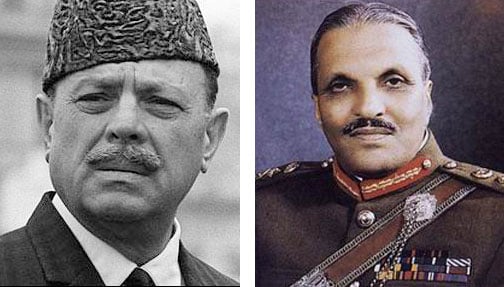
Picture reproduced from Dr Naazir Mehmood, “Towards a diverse narrative“, The News, July 20, 2014. All rights belong to the original owner.
When a dictator begins to lose legitimacy, they try framing themselves as democrats. This paper explores how two military dictators in Pakistan – Ayub Khan and Zia ul Haq – attempted to strategically use the electoral process to legitimize their regimes. Guided by Carl J. Friedrich’s definition of legitimacy, the paper comparatively analyzes Ayub Khan’s 1960 referendum and 1965 elections as well as Zia ul Haq’s 1984 referendum and 1985 elections. This is done by contextualizing the regimes’ desperations for legitimacy that led to the referendum/elections, narrating the events of the polling exercise and then evaluating how it affected public perceptions of legitimacy and, in turn, the power of the two leaders. Ultimately, the paper concludes that both Ayub Khan and Zia ul Haq failed to legitimize their rules through their manipulated referendums and general elections; however, Ayub Khan was able to maintain a firmer control of state affairs during this process than Zia ul Haq.
While researchers often individually discuss the policies of Pakistan’s military rulers and their socio-economic impacts, this exploration aims to comparatively analyze how Ayub Khan and Zia ul Haq tried to deal with perhaps the most pertinent threat to military rulers anywhere in the world: the dilemma of legitimacy.
 Muhammad Ammar